
Protecting disfavored research
(with a side of puzzles)

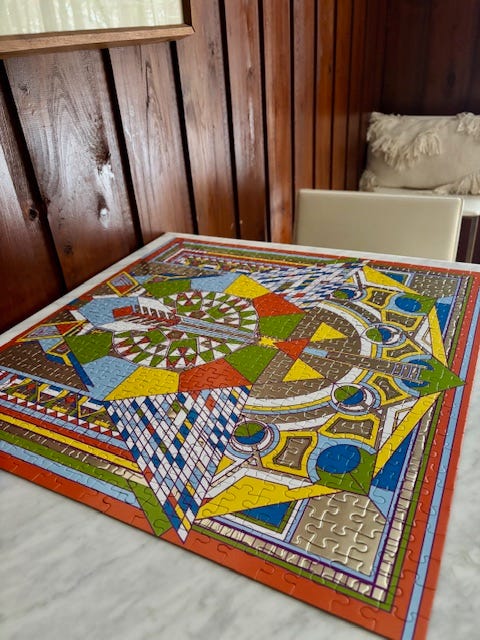
Dear Frog Troublers, how are you faring in this snow and ice storm? We have decamped to a house in town, where we’re reading and cooking and doing puzzles with our share-a-driveway neighbors, Jaimee and Josh. Friday after school, when Harriet remembered that we were spending the weekend with them, she said, “Yay Jaimee and Josh!” That’s what she says whenever these neighbors are mentioned—we’re pretty lucky to live next to them.
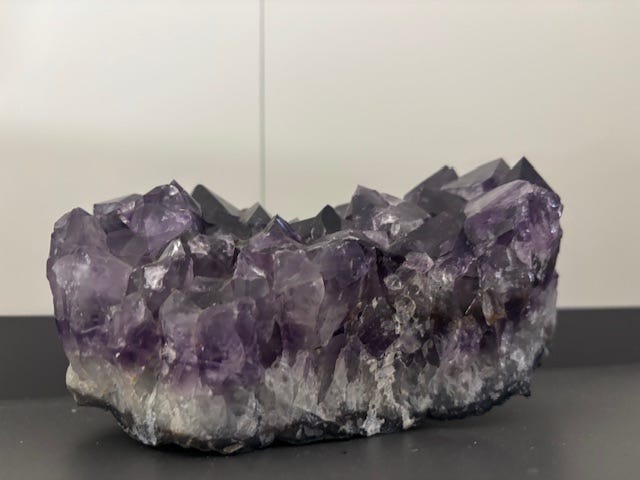
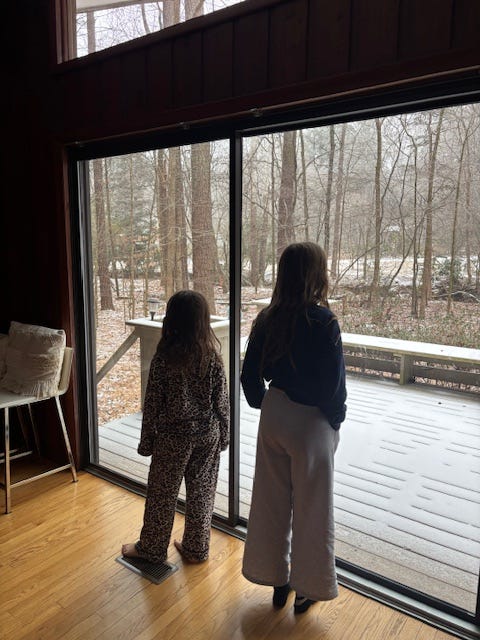
The house where we’re staying is lovely—lots of windows for watching thundersnow, which is predicted in the next hour—and a large crystal in every room. Harriet has informed me that several witches and a yeti inhabit the house. I brought some art supplies so I think we might make a book of the crystals and supernatural beings today.
This week was a tough one. One of my responsibilities as AAUP NC president is to monitor the requests that come into our free legal hotline, which we set up in the fall for members facing First Amendment and academic freedom issues. For a while I was getting one or two inquiries a month, but on January 15, all UNC system syllabi became public records by decree of system President Peter Hans and the UNC System office. Now it’s more like three or four a day.
Peter Hans works on the 18th floor of a secure high rise building in Raleigh. Back in December, when we delivered our petition opposing this dangerous decision, the closest we could get was the 9th floor.
The next week we were able to meet on Zoom with Hans, sharing our concerns about the danger to our personal safety as well as the chilling effect on research, scholarship, and teaching. We told him that faculty would avoid teaching classes that draw attention from right-wing groups, threatening our jobs and possibly our lives, and that would be bad for students, bad for the university system, and bad for North Carolina. We said we don’t want our classes disrupted or our students endangered or afraid they say might be secretly recorded by someone with the intent to harm, shame, or silence.
Without providing any specifics, Hans told us that he felt confident that the university system could handle any threats, and that this move was necessary for transparency. One of my colleagues at that meeting, a social work professor who specializes in violence prevention, asked Hans and his staff if they had considered using speculative design to consider and prepare for the potential consequences of this widespread, hastily decided policy change. I don’t think they’d heard of speculative design, but also they did not ask this faculty expert, with 79 research publications to her name, for more information. In his Zoom background, I could see President Hans’s spacious, well-appointed office—high ceilings, gleaming bookshelves. I did not see a single book.
Here are some of the university departments that are experiencing public records requests for past syllabi: Education, Journalism, Psychology, Geography, Anthropology, Asian and Middle Eastern Studies, Comparative Literature, American Studies, French, English, Communications, Political Science, Religious Studies, Public Administration, African American and Diaspora Studies, Germanic and Slavic Languages, Women’s and Gender Studies, and Religious Studies (Islamic Studies). Do you teach one of these subjects? Did you take a class in one or more of them in college, or are your children and grandchildren taking classes in these subjects now?
And here’s the thing about transparency in the UNC system: it already exists. If you are a student interested in a class, or even a member of the public, there are already ways to find out more about it. Let’s take “The Black Press and United States History,” one of the FOIA’d classes, as an example. One could learn more about it by searching the course catalog, which describes the class as “a chronological survey of the African American press in the United States since 1827. Emphasis is on key people and issues during critical areas in the African American experience.” A student who wanted to know more could contact the professor, who would provide a syllabus, including a list of readings and the major assignments. We are proud of our syllabi and want students to be prepared for our classes.
But these requests, so far, are not coming from students—not even from parents. They’re coming from well-funded right-wing groups like The Oversight Project, which was established by the Heritage Foundation (of Project 2025 infamy) to target disfavored subjects and make it hard to teach them. Or from the conservative James G. Martin Center for Academic Renewal, which advocates for removing the role of research from the university.
It occurs to me that The Legend of Wyatt Outlaw is an example of government-disfavored research. That makes me more determined to share it. It’s about protest and art, multiracial democracy, journalism and education and the law. It’s also about white supremacy, police violence, and the lie of Lost Cause narratives. I haven’t done the greatest job of posting about our tour dates (though I am trying to make up for that), so it would mean the world to me to see you (or your friends) at some of these free events. In Chapel Hill? The Love House event will be with Gene Nichol, who has some dynamite questions planned. In Pittsboro? The McIntyre’s event will be with Mike Wiley! In Burlington? We moved the launch date to Feb 3—there will be cake and music!
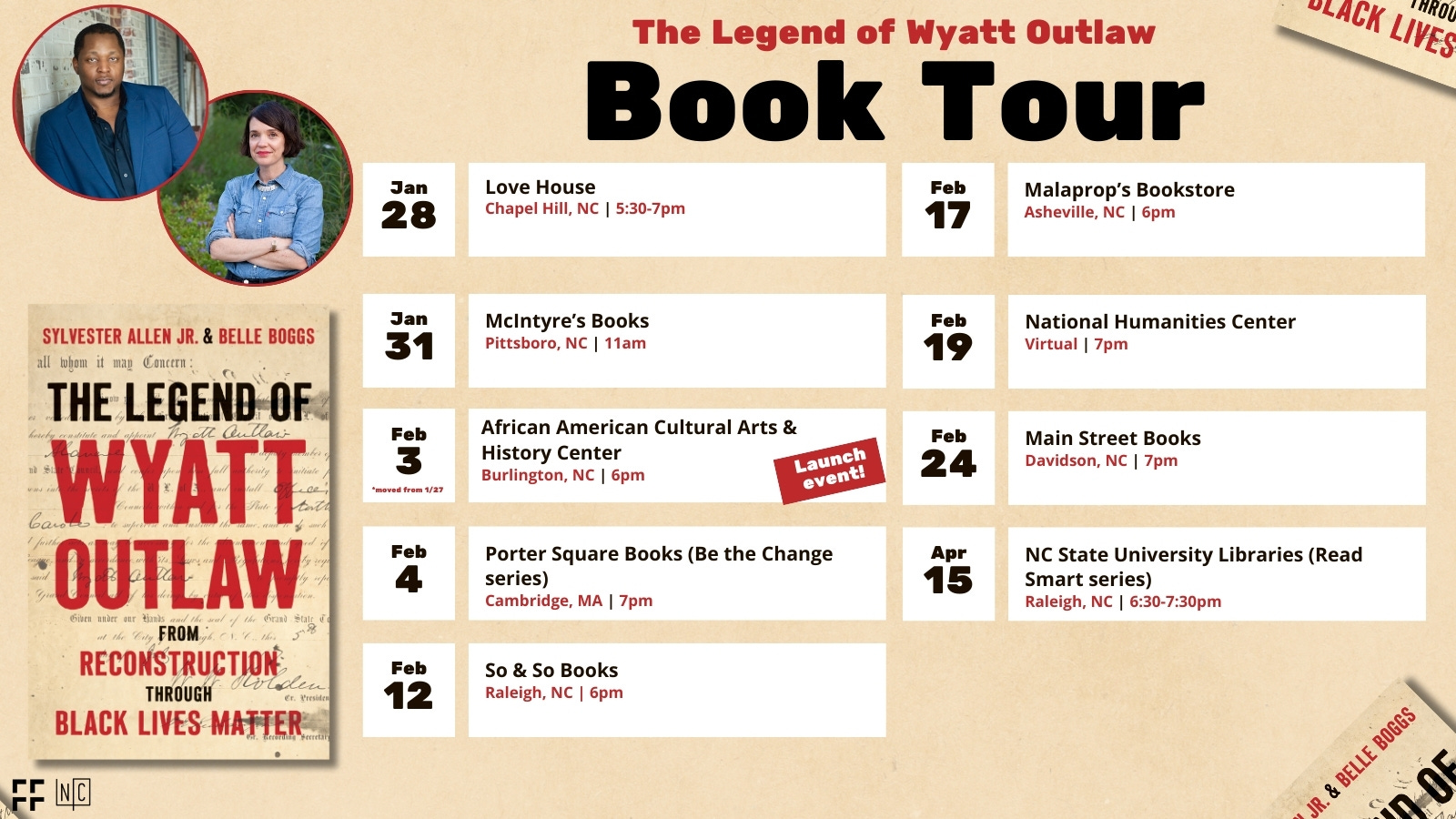
Sylvester and I recorded an interview with one of my favorite NC journalists, Leoneda Inge, on Wednesday. The interview goes live tomorrow. I’m afraid the beginning will sound a little awkward because when Leoneda asked me, “Who was Wyatt Outlaw?” I sputtered what a lot of people who do know him already know: that he was the first Black town commissioner of Graham, North Carolina. Then she prompted, “and he was a businessman too, right?” Yes, I said—he was a cabinet maker and carpenter who built coffins for paupers. And a tavern owner! And a voting rights leader and Union League leader. And a father, a son, a family man and person of faith who, when he had a chance to invest in property, bought land not for himself but for a church and a school for his community.
It’s astonishing to think of all that Wyatt did in his too-short life, what so many Black leaders committed to the radical idea of equality and multiracial democracy managed to do during Reconstruction. How violently and virulently they were opposed. How hard the side of white supremacy had to work to spin lies about people who believed in the promise of “freedom and good government,” as Union League members pledged at each meeting under Wyatt’s direction.
Truth and bravery met with lies and masks, patriotism met with treachery. That is the story of Reconstruction. It is also the story of right now—what Peniel Joseph and Reverend William Barber call the Third Reconstruction. How it ends, where it goes, is up to us.
Lots of love to you, and to those brave protesters in Minneapolis. Abolish ICE.
I teach in one of those targeted areas—women’s literature—and am feeling watched this semester. On purpose, I started the semester with The Handmaid’s Tale. The class has been pointing out the parallels to our society today: freedom of speech threatened, the press and other media attacked, universities attacked, women’s rights removed, and “secret police” roaming our streets. We have to draw the line NOW before it gets worse. We need to take a stand and prepare to fight. Our freedoms are all at risk.
Thank you for the work you all are doing to protect our teachers, researchers, and students.