
Pollinators and AI
& a farmer who's not real

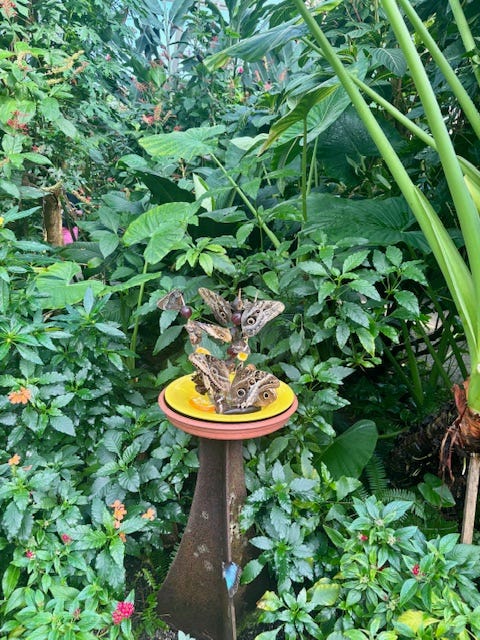
“Look!” Harriet said, pointing at a flowering bush swarming with bees. “Pollinators.”
We were leaving her piano lesson, which she takes every Monday afternoon at Ms. Shelley’s house. It had been warm enough for me to sit outside during the lesson, reading my graduate student’s thesis, a brilliant and dense collection of speculative and science fiction stories. Harriet is still plink-plunking because I don’t make her practice enough from the book—she likes to make up her own songs—but piano lessons are a good in our life. Ms. Shelley, who lives near our favorite county park, has a cat named Lucy, a fragrant fruit tree orchard, and flocks of ducks and chickens whose eggs we buy every week.
In the car on the way home, Harriet told me more about pollinators. How bees and butterflies taste with their feet, how the bee collects nectar and how some of the pollen gets stuck to its thorax. When it goes to the same kind of flower and does that again and again, that’s how the flowers grow.
“We’re researching it in the library. But,” she said, her voice low and serious, “we are using AI.”
Harriet knows how I feel about AI in a general way, but like most students she has her own perceptions of its value.
“We go on the computer, and we talk to a farmer named Tom. Except he’s not always named Tom and he’s not really a farmer. He’s not really real at all.”
The student whose book I was reading in Ms. Shelley’s yard once told me, choosing among classes, that she didn’t want AI anywhere near her education. That sums up how I feel about my children’s education nicely, but does not account for the ways educators are being coerced, encouraged, and sometimes forced to use it. Sweet second graders! Using AI to study something in books and right outside their doors—AI which burns water and resources and money and forests. AI which destroys the very habitats of the creatures they are studying.
I was grateful to chaperone a field trip with Harriet’s class later in the week to the Museum of Life and Science. Before going into the butterfly house, her second grade class talked about insects and metamorphosis with a museum educator. They stroked a millipede with two fingers and peered through a digital microscope at butterfly wings. Inside the humid greenhouse, butterflies landed on kids from all over the Triangle. A museum volunteer swiped Harriet’s fingers with sugar water, and a Blue Morpha stepped from his fingers to hers.
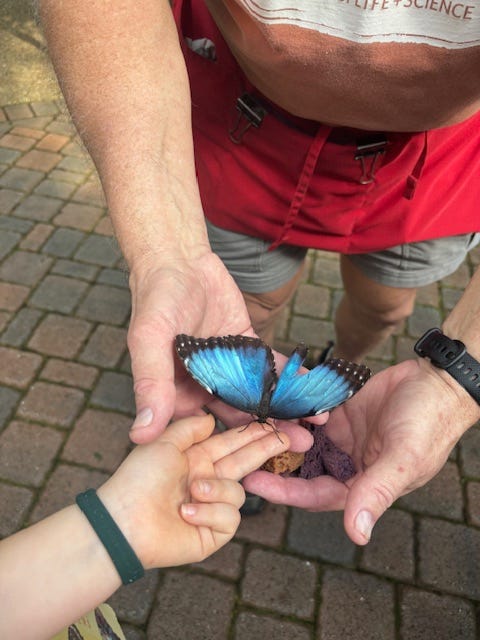
“Its wing is torn,” Harriet noticed. “Will it be okay?”
“Oh yes,” the man answered. “It takes a lot more than that to kill it.”
Today we’re going to practice piano, prepare the garden, and plant some wildflower seeds we ordered from Sow True Seed. I’m also going to re-up our CSA subscription to In Good Heart Farm, the best farm share ever, with pickup locations in Cary, Raleigh, and Chatham County. In Good Heart Farm allows you to choose what goes into your weekly or biweekly box of veggies and fruit, and they send you a wonderful newsletter. We especially love their tomatoes, herbs, strawberries, herbs, lettuces, greens, peppers, radishes, beets, potatoes, and seedlings. They still have spots available for their spring season, which starts in just a month.
How about you, Frog Troublers? What does your Sunday look like? Have you noticed AI invading your school or workplace, and how are you experiencing it?
Lots of love from us.
Thank you for talking about something troubling in a way that wasn't about finding a solution, just being with it, together.
I love this piece. Especially the photos. But also, all of it. Thanks, Belle.